See the whale 'attack' story featured in New Scientist, fairly quoting Giuseppe Notarbartolo di Sciara and Giovanni Bearzi:
http://www.newscientist.com/article/dn19213-teenage-drivers-why-whales-smash-into-boats.html

Showing posts with label notizie/news. Show all posts
Showing posts with label notizie/news. Show all posts

22 July 2010
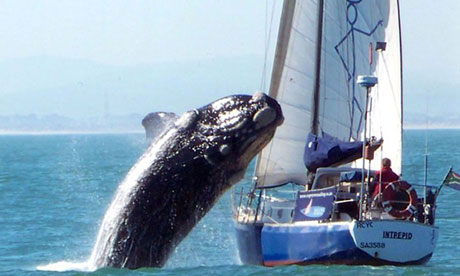
Whales "attacking" boats?
http://www.guardian.co.uk/science/2010/jul/21/whale-yacht
A presumed 'attack' by a right whale to a small sailing boat is having considerable media coverage in these summer days.
This, however, looks more like an accident made up by the press than a habitual or intentional behaviour. Some even suspect the image with the whale might be a smart PhotoShop product, i.e. an ex-post representation of a real event.
The cetacean species known to intentionally attack and occasionally sink small boats is the killer whale, possibly because boats do not respond to warning signals by the whales, who may be engaged in critical activities when a boat approaches too closely and suddenly. The animals may just try to react to an intrusion, behaving in the same way as several other large and wild mammals would (e.g. elephants, rhinos, hippos or apes). Killer whales do that because they, too, are wild and large mammals who care about their territory. Sinking boats is a rare event anyway, considering how often boats disturb killer and other whales - either deliberately or not - in virtually all oceans.
While I did not investigate the occurrence of right whale 'attacks' in the past, I remember a similar report involving a whale calf (either a right whale or a similar species) one or more years ago. As far as I can recall that was most likely an error by a playful calf, not an attempt to harm humans. In any case, such behaviours may have meanings other than deliberate attacks. If there was any aggressive intention, it remains to be seen why the whales reacted as they did (had they been harassed for too long?).
More generally speaking, I am often disturbed by the morbid interest shown by the media in depicting wild animals as dangerous beasts. In Italy, there is plenty of stupid TV programmes of that kind, totally uninformative as well as non-educational for children. Titles such as 'whale attacks boat' may work well in the media marketplace but they encourage irrational ancestral fears rather than inspire awe and appreciation for wonderful and disappearing animals. I've also seen media articles featuring 'attacks' by jellyfish, as if jellyfish (animals devoid of a central nervous system) could possibly have an intention whatsoever.
Giovanni Bearzi
13 May 2010
First gray whale in the Mediterranean Sea

A few days ago an adult gray whale (Eschrichtius robustus) has been spotted off Israel. Researchers from IMMRAC (Israel Marine Mammal Research and Assistance Center) photo-identified the animal and recorded behavioural data. They followed her for about two hours from Herzliya Marina (close to Tel Aviv) to Jaffa, where she was last spotted heading south.
Robert Brownell, a famous cetacean expert, said this is "The most amazing sighting in the history of whales". The sighting is indeed intriguing: first observation in Mediterranean waters and, because the animal must have come from the Atlantic Ocean where the species is believed to have been extinct for about 300 years, first time in Atlantic waters after so many years.
The grey whale might have travelled from the Pacific Ocean, the only area where the species is found, to the North Atlantic. Experts are now discussing which could be the most reasonable route: through the Panama Channel, the Northwest Passage or around Cape Horn?
Silvia Bonizzoni
---
Photo: the flukes of the gray whale, by Aviad Schenin / IMMRAC
For more information:
http://www.petethomasoutdoors.com/2010/05/gray-whale-sighting-off-israel-a-truly-remarkable-event-.html
http://news.bbc.co.uk/earth/hi/earth_news/newsid_8672000/8672970.stm
30 April 2010
Monk seal shot in Greece

On April 27, a young monk seal of about four months was found in Northern Evoia, Greece, with a severe head injury.
The seal - a male - was still alive and he was rescued by MOm together with local vets. According to Vangelis Paravas of MOm, the seal was shot. One eye is lost and around it there is a large infected wound. The nasal cavity is damaged and the animal cannot dive. At the moment the seal is blind and unable to feed.
The poor seal is being provided first aid and medications and he was transferred to the wildlife clinic of the Veterinary School of Thessaloniki for rehab.
Senseless killing of critically endangered marine mammals is a crime towards both the animals and biodiversity. We humans do not own this planet: we share it with other creatures and we owe them respect.
Mediterranean monk seals survive in very low numbers, mostly in Greece. We should value their presence and welcome with great joy the animals' timid efforts to get back to healthy population numbers. What ignorant can ever think about shooting a young monk seal in the head, perhaps seeing this beautiful animal merely as a "competitor" for fish resources?
The day when there will be no competition by monk seals and dolphins - and therefore none of these animals around - will be a very sad day.
Giovanni Bearzi
---
Photo of the injured monk seal by Vangelis Paravas / MOm
06 April 2010
Peroni and Tethys

The Italian brewing company ‘Peroni’ donated 3000 cans of beer to Tethys.
Volunteers participating in Tethys field courses will surely enjoy such a refreshing drink on the patio of the Galaxidi field station, or on the deck of the Pelagos boat.
We are grateful to Peroni for their contribution to our field activities.
SB
01 March 2010
Should killer whales not kill?
Killer whale kills SeaWorld trainer
Orca uccide addestratrice del SeaWorld
Why not let orcas kill their own prey in the wild, instead of using these top predators as toys and then be shocked if some of them, sometimes, behave as wild animals?
Giovanni Bearzi
Orca uccide addestratrice del SeaWorld
Why not let orcas kill their own prey in the wild, instead of using these top predators as toys and then be shocked if some of them, sometimes, behave as wild animals?
Giovanni Bearzi
25 February 2010
Whale funeral

A few days ago, a 16-m long dead whale was spotted along the Vietnamese coast and local fishermen hauled it ashore.
In Vietnam's fishing culture whales are considered sacred and the dead animal is attracting people from throughout the region. Fishermen are burning incense in its honour and they are planning to build a temple at the burial site.
Whales are named 'ngai': the honorific title used for kings, emperors and esteemed leaders.
SB
---
Photo: dead whale dragged ashore (by The Associated Press)
For more information:
http://www.miamiherald.com/2010/02/23/1494845/thousands-give-last-rites-to-dead.html
21 February 2010
WDCS Species Guide

WDCS The Whale and Dolphin Conservation Society has recently launched a new online species guide.
The guide comes in three languages (English, Deutsch and Spanish), and provides information about appearance, distribution, behaviour, classification and threats for each cetacean species. It also features 80 maps and over 400 images.
Have a look at the WDCS Species Guide.
24 January 2010
Guinness migrations

Speaking about the ‘Guinness World Records’ I thought grey whales (Eschrichtius robustus) and humpback whales (Megaptera novaeangliae) were the animal with the longest migration ever recorded, with approximately 16,000-20,000 jm on their annual journey.
But I had failed to consider the avian world and so, I was completely wrong.
A recent study found out that a little bird weighing less than 125 gr, the Arctic tern (Sterna paradisaea), is the winner in this "competition".
Thanks to tiny devices attached to 11 Arctic terns, researchers were able to track their routes and find out exactly where they went during a full-year of migration. From the breeding to the wintering grounds and back again, travelling between 280 and 670 km per day, they did a pole-to-pole migration totalling 70,900 km!
Never overlook a tiny little bird!
Silvia Bonizzoni
---
Photo: Geolocation tracks of 11 Arctic terns, from the Egevan et al. article.
Egevang C., Stenhouse I.J., Phillips R.A., Petersen A., Fox J.W., Silk J.R.D. 2009. Tracking of Arctic terns Sterna paradisaea reveals longest animal migration. PNAS. 4pp.
For more information:
http://news.bbc.co.uk/2/hi/science/nature/8451908.stm
22 January 2010
Whales and dolphins in Salento

Today, January 22nd, Giovanni Bearzi gave a 2-hour lecture at the University of Salento (Lecce, Italy), centred around research done by the Tethys Research Institute in the Mediterranean Sea over the past 25 years.
The event, organised by Dr. Paolo Guidetti - one of the foremost experts on marine protected areas - took place in the prestigious University for a selected group of teachers, researchers and students.
Dr. Guidetti kindly introduced the work done by Bearzi and colleagues and presented Tethys as an Italian centre of excellence for cetacean research.
Bearzi’s seminar, titled "Twenty years of cetacean research in the Mediterranean: what for?", started with an overview of the work done by Tethys in several parts of the Mediterranean, to proceed with presentations on research projects focusing on population abundance estimates, interactions between dolphins and fisheries, and today's conservation challenges.
Bearzi also showed the Disappearing Dolphins documentary and then closed with a presentation on the recent mass stranding of sperm whales in Apulia, reporting on the amazing changes occurred in the public perception of these animals.
Silvia Bonizzoni
07 January 2010
Sea Shepherd’s trimaran collision

On January 6th, the high-tech carbon fibre trimaran ‘Ady Gil’, belonging to the anti-whaling group Sea Shepherd, was destroyed after a collision with a Japanese vessel.
The Ady Gil was designed to run on low-emission renewable fuels and was built with peculiar materials to reduce the probability to be detected by the radars of whaling vessels. Its goal was to intercept and physically prevent ships from slaughtering whales, and at least reduce the illegal whaling occurring in the Southern Ocean Whale Sanctuary.
After only one month from its official departure, however, the Ady Gil was crashed by the Japanese security ship Shonan Maru 2, the boat used by whalers to "protect" the Japanese fleet.
All six crew members of the Ady Gil were rescued, but there are no chances to save the trimaran.
Despite this catastrophic damage, the anti-whaling group is not giving up. As the Sea Shepherd’s captain, Paul Watson, said: "If they think that our remaining two ships will retreat from the Southern Ocean Whale Sanctuary in the face of their extremism, they will be mistaken.”
Silvia Bonizzoni
---
Photo by: AFP/GETTY
For more information:
http://www.telegraph.co.uk/earth/earthnews/6939571/Anti-whaling-ship-sinks-after-collision-with-Japanese-vessel.html
http://www.seashepherd.org/news-and-media/news-100105-4.html
21 December 2009
Sperm whales: final destination

Between December 10th and 11th seven sperm whales stranded and died - on the northern coast of the Gargano Peninsula (Apulia, Italy). They were all sub-adult males.
After several meetings the experts decided what to do with the dead animals, but in the meantime the carcasses are still on the beach. Each animal will be cut into parts. Carcasses will then be buried and covered with ground and lime. The decomposition process is expected to complete in one year. At the end of this period the skeletons will be recovered, treated and displayed in museums.
Numerous hypotheses were made regarding the causes of the stranding, from plastic ingestion to seismic surveys, seaquakes, etc. But the fact is: the reasons are still unknown and the experts are working hard to find out.
Silvia Bonizzoni
14 December 2009
Mass stranding of sperm whales in southern Italy

An updated photo album as well as a low-resolution video of two agonising sperm whales can be viewed at:
http://www.istitutotethys.org/gargano/
12 December 2009
Mass stranding of sperm whales

Between Thursday 10 and Friday 11 December a pod of seven sperm whales stranded on the coast of the Gargano Peninsula (Italy), in the Adriatic Sea.
The animals, including several males of 10+ m, are scattered along a stretch of about six km of beach. Five have already died.
Scientists from the Centro Studi Cetacei, the Natural History Museum of Milan, and the Italian universities of Bari, Padua, Pavia and Siena, among others, are on site and coordinate operations and scientific analyses.
Giovanni Bearzi and Silvia Bonizzoni, who live in Apulia not too far from the stranding area, went to have a look.
See what they found:
http://www.istitutotethys.org/gargano/
09 December 2009
Oceans for Pathi

Oceans for Pathi is a new nature film based on revolutionary techniques that allowed enjoying the secrets of the oceans as never before.
Thanks to remote-controlled mini helicopters and hydrodynamic cameras, the film reached the goal of ‘catching’ the ocean's most intimate events. For this purpose the crew worked in 50 different locations and filmed 80 marine species, from crabs to whales.
It took four years, 500 hours of footage and £45 million to be produced but the result must be amazing!
The film will be out for general release by the end of January 2010.
SB
----
Photo by Barcroft Media: an example of how some whale footage was obtained.
More information in the DailyMail article
01 December 2009
EU funded tens of millions to fish for depleted tuna
 The European Union has given out €34.5 million, between 2000 and 2008, to subsidise the Mediterranean tuna fishing fleets despite warnings from scientists that overfishing is pushing the species close to extinction.
 Joe Borg, the European Fishery Commissioner, revealed that €23 million was given to fund the construction of new boats, including ultra-modern purse seiners that are able to land 100 tonnes in one haul. A further €10.5 million was given to modernise existing vessels, increasing their ability to track down and catch the tuna. Only €1 million was used to decommission vessels, but mainly for small-scale, local boats.
Spain received more than half of the subsidy, with French and Italian fleets the next biggest beneficiaries. Cyprus, Malta and Greece were also given money.
Scientists from ICCAT (International Council for the Conservation of Atlantic Tuna) believe that the bluefin tuna stock was below 15 per cent of its pre-exploitation levels.
Read full article on the Times
Eleonora de Sabata
30 November 2009
State of the Med: the UNEP 2009 report
 The UN Environment Programme (UNEP) Mediterranean Action Plan (MAP) and its Regional Activity Centres have released the first State of the Environment and Development report covering the Mediterranean region, which tackles key environmental issues, including climate change. The “State of the Environment and Development in the Mediterranean 2009″ was released during the 16th Meeting of the Contracting Parties to the Barcelona Convention, which took place from 3-5 November 2009, in Marrakech, Morocco.
 The report is a pilot exercise, based on available sources of information and covers the 21 countries bordering the Mediterranean Sea. It finds that climate change is already occurring in the region and forecasts that it will lead to, inter alia, a decline in rainfall, increased periods of droughts and rises in sea-level. The report also identifies the most vulnerable Mediterranean zones and states that climate change will also affect agriculture and fishing, the attractiveness of tourism, coastal zones and infrastructure, and public health.
Eleonora de Sabata
---
26 November 2009
Whale-ship collisions featured on Italian TV

On November 23rd, Tethys researcher Sabina Airoldi, director of the Cetacean Sanctuary Research project, took part in the TV programme Geo&Geo, aired on the Italian channel Rai Tre.
Sabina talked about whales and dolphins in the Mediterranean Sea, particularly in the Pelagos Sanctuary, also discussing the problem of collisions between ships and large whales.
Following Sabina's participation in this popular TV programme, the website on whale collisions managed by Tethys had several hundreds of new visitors from all over Italy in the following days. It was an important opportunity to let the general public know about the cetacean conservation initiatives conducted by Tethys.
Elisa Remonato
25 November 2009
A new FAO treaty to crack down on illegal fishing

Rome, Nov 23 2009 - A new FAO treaty to fight illegal fishing - finalised by 91 countries - is now open for signature by member states. The agreement will legally enter into force after 25 countries have ratified it.
Officially known as the Agreement of Port State Measures to Prevent, Deter and Eliminate Illegal, Unreported and Unregulated (IUU) Fishing, the treaty specifies minimum standards for inspection.
Under the terms of the text, foreign vessels will have to request permission in advance to dock at specially designated ports and will have to provide information on their catch. Signatories will also commit to regularly inspect fishing vessels in their ports according to a set of international standards. Port States will be obliged to prohibit entry to illegal fishing vessels.
So far the situation is not good: a research by the Pew Environment Group shows that while some vessels known to engage in IUU fishing are penalised by port authorities, many are entirely unaffected or simply manage to escape penalties by moving out of the convention area where they were listed.
Environmental groups estimate that one-fifth of all fish landed are caught illegally.
Eleonora de Sabata
photo: FAO/G.Bizzarri
---
For more information:
Pew Environment Group: Port State Performance
FAO press release: New treaty will leave ‘fish pirates’ without safe haven
18 November 2009
The end of Japanese whaling?

A review of Japanese government spending could put an end to Japanese whaling in the Southern Ocean Whale Sanctuary.
Japan's new government is looking for ways to cut useless costs and, to reach this goal, the new prime minister Yukio Hatoyama has established a spending review committee.
This committee has recently proposed massive cuts in subsidies to the Overseas Fishery Cooperation Foundation (OFCF), the largest financer of the Institute of Cetacean Research (ICR) which runs the so-called ‘whaling research programme’.
The committee recommended that the OFCF, which gives loans to the ICR, have all of its funding revoked, except monies needed for loans in 2010.
It seems that the whaling research program is not able to cover its costs, and without government subsidies it could be finally destined to an end.
The spending review committee will review funding of the Ministry of Foreign Affairs Grant Aid programme during the week of November 24th.
SB
---
Photo by: Australian Custom Service
For more information:
Article on Environment News Service web-site
Article on Greenpeace web-site
Subscribe to:
Posts (Atom)